
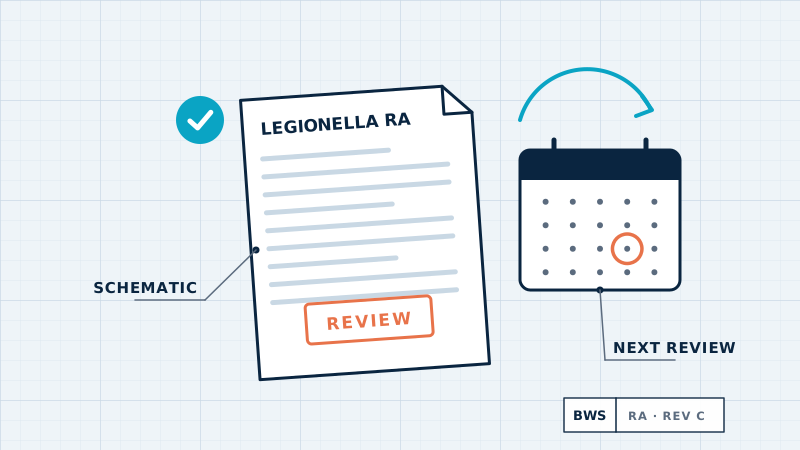
The short answer
There is no fixed interval in the current law or guidance. ACOP L8 (fourth edition, 2013) says the assessment must be reviewed regularly, and specifically whenever there is reason to suspect it is no longer valid. The “every two years” figure that still circulates came from the previous edition and was deliberately taken out.
In practice most duty holders settle on a two-year cycle for a stable, low-risk building, annually for anything higher risk, and a review at any point when something changes. That is a reasonable position, provided you can explain why you chose it. What does not stand up is a five-year-old assessment with nobody able to say when it was last looked at.
What the guidance actually says
ACOP L8 puts it this way: the assessment should be reviewed regularly and specifically when there is reason to suspect it is no longer valid, for example when there has been a change to the water system or its use, a change in the building's use, new information about risks or control measures, results of checks indicating controls are no longer effective, changes to key personnel, or a case of Legionnaires' disease associated with the system.
HSG274 Part 2 adds the practical layer: the written scheme and the risk assessment are living documents that the monitoring programme feeds back into. If a quarterly temperature round keeps finding the same outlet below 50°C, that is new information, and the assessment should reflect it.
Healthcare sits under its own guidance. HTM 04-01 expects a risk assessment review at least every two years and more often where the water safety group decides the risk warrants it, so for an NHS estate the two-year figure is still the baseline.
Nine things that mean your assessment is out of date today
Work through these honestly. If any of them has happened since the date on the front of your assessment, the document no longer describes your building, whatever its age.
- Pipework has been added, removed or re-routed — an extension, a refurbishment, a tenant fit-out, a capped-off wing.
- The hot water plant has changed: a calorifier replaced, a plate heat exchanger added, a point-of-use heater fitted.
- Outlets have been added or taken out of use. A closed washroom is a dead-leg nobody has written down.
- Occupancy has changed — a floor let to a new tenant, a school converted to a nursery, a care home ward reopened.
- The building was empty for an extended period, including a long shutdown or a pandemic-era closure.
- The responsible person, deputy or contractor has changed. The assessment names people; if those people have gone, the control scheme has a hole in it.
- Monitoring has repeatedly flagged a problem: persistent low hot temperatures, high cold temperatures, positive samples, failed TMVs.
- There has been a case of Legionnaires' disease connected to the building, or a positive result that triggered a disinfection.
- The assessment itself was poor — a desktop exercise, no schematic, no outlet list. A bad assessment is not improved by being recent.
Choosing a review cycle you can defend
A defensible position has two parts: a scheduled review interval written into the written scheme of control, and a list of triggers that bring the review forward. The interval depends on the building.
For a small, simple, stable building — a single-storey office on a mains-fed system with instantaneous hot water — two years is reasonable and some would argue for longer with a documented annual check that nothing has changed. For a multi-tenanted commercial block with stored water, a calorifier and TMVs, annual is sensible. For healthcare, care homes, student accommodation, leisure centres and anything with a cooling tower, annual at most, and the assessment should be revisited at every water safety group meeting.
Whichever interval you choose, write it down in the scheme of control with the reason. “Reviewed every two years because the system is simple and the monitoring record shows consistent control” is a sentence an inspector can accept. A blank is not.
What a review involves
A review is not always a full new assessment. If nothing has changed, the review can be a documented check: walk the system against the schematic, confirm the outlet list, confirm the named people, look at the monitoring record for the period, and sign and date the front sheet. That might take an afternoon.
If something on the trigger list has happened, the affected part of the assessment needs redoing properly — survey, schematic update, re-scored risk, revised control measures. Where the change is large, a fresh assessment is cleaner than a document with three generations of amendments.
Either way the output is the same: an assessment that describes the building as it is now, with a date and a name on it.
How BWS helps
We carry out Legionella risk assessments to BS 8580-1 across the West Midlands and the UK, and we build the review cycle into the monitoring programme so the question never has to be asked from a standing start. If you are unsure whether your current assessment is still valid, send us the front page and the date and we will tell you.
The cost of a review is a fraction of the cost of the inspection, the outbreak investigation or the insurance claim that follows an assessment nobody could stand behind. Our guide to what a risk assessment costs covers the price bands.