
Why an empty building is a risk, not a rest
A water system is kept safe by three things: movement, temperature and treatment. A shutdown removes the first, degrades the second and, if the plant is switched off to save energy, often removes the third as well.
When nobody draws water, it sits. Cold water in a plant room that is still heated creeps up towards 20°C; hot water left in a calorifier that has been turned down drifts into the 20–45°C band where Legionella multiplies fastest. Biocide in a closed heating circuit is not replenished. Thermostatic mixing valves sit full of lukewarm water. Two weeks is enough for counts to rise in a system that was fine in November.
HSG274 Part 2 treats any outlet unused for a week as “little used” and expects it to be flushed. Over Christmas most buildings have hundreds of them.
Before you lock up: the pre-shutdown checklist
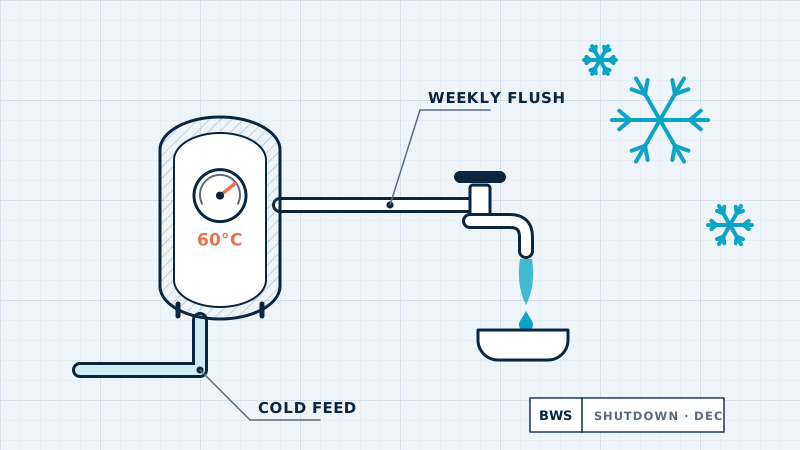
Decide what stays on. The instinct is to turn the hot water plant off to save gas. For a shutdown of under a month, HSG274 says the safer option is usually to keep calorifiers at storage temperature (60°C) and keep the secondary circulation running, so the system stays hot even if nobody uses it. If it must go off, plan for a full reheat and flush before reoccupation.
Record the baseline. Take and log temperatures at the sentinel outlets, the calorifier flow and return, and the cold water storage tank on the last working day. In January you will want to prove what changed.
Protect against freezing. Cold water storage tanks in roof voids, external pipework and dead-legs in unheated plant rooms are the usual casualties. Check lagging, confirm frost protection on any heating circuit that serves them, and make sure the building's frost-stat setting is one somebody has actually checked rather than assumed.
Arrange a mid-shutdown flush. If the building will be shut for more than seven days, somebody needs to flush the little-used outlets at least once a week — run each tap and shower until the water reaches temperature, with the shower head removed or the spray directed away from the operator to avoid aerosol. For a school or an office this is normally a caretaker or security visit with a simple sheet to sign. It takes an hour and it is the single most effective thing on this list.
Closed systems too. Heating and chilled circuits do not carry Legionella risk, but a system left cold and static for weeks is where corrosion and bacterial fouling take hold. Check inhibitor and biocide levels before the break and make sure the circulation pumps are on a timed run rather than fully off.
During the shutdown
Keep the weekly flush going and keep the record. If the heating fails or a pipe freezes, that is now a water hygiene event as well as a maintenance one — note the date, what was affected and how long it was out.
If the shutdown stretches beyond a month, the guidance changes: HSG274 suggests either draining the system down or, if that is impractical, continuing the weekly flushing and planning a disinfection before reoccupation. A month without water movement in a hot and cold system is the point at which we would normally recommend sampling on return rather than relying on temperatures alone.
Before anyone turns a tap on: the reoccupation routine
The riskiest moment is the first morning back, when a hundred people arrive, every outlet is used at once and whatever has grown over the break is aerosolised in the showers and washrooms. The reoccupation routine happens before that, ideally the day before.
Bring the hot water plant back to temperature first and confirm 60°C at the calorifier and at least 50°C at the furthest outlet within a minute of running. Then flush every outlet, starting furthest from the plant and working back, until the cold water is below 20°C and the hot is above 50°C. Check that TMVs are delivering the right mixed temperature. Record all of it.
If the system was off for more than a month, or temperatures were out of range during the break, or there is any history of positive results, take a set of samples before full reoccupation and consider a disinfection. A clean result on the day people return is worth considerably more than one taken in February after the complaint.
Who is responsible
The duty does not pause for Christmas. Under ACOP L8 the responsible person still has to be able to show that the risk was managed during the shutdown — which in practice means the flushing record, the temperature log and a note of what was decided about the plant. An auditor in March will ask for exactly that.
Where a managing agent, a facilities contractor and a landlord all have a hand in the building, agree before the break whose caretaker does the flush. The gap we see most often is not a missing procedure; it is three parties each assuming another one had it covered.
How BWS helps
For managed clients we build the shutdown into the monitoring programme: a pre-closure visit for baseline temperatures and plant settings, a weekly flushing visit if there is nobody on site, and a reoccupation visit with temperatures, TMV checks and sampling where it is warranted. For everyone else, we can quote for a one-off pre-Christmas check and a return visit in the first week of January.
If you are not sure what state your building will come back in, call us before you close rather than after you reopen. The December visit is the cheap one.